

The Art of Revitalization: Why Reupholstering Vintage Furniture is a Game-Changer
Much of my personal style has been influenced by pieces handed down to me from family members. Luckily, my mother loves an interesting furniture find as much as I do and has that “why not?” mentality that I inherited.
As in, found a great antique set of armchairs and settee 1500 miles from home? Have to rent a U-Haul to tow them back? WHY NOT?
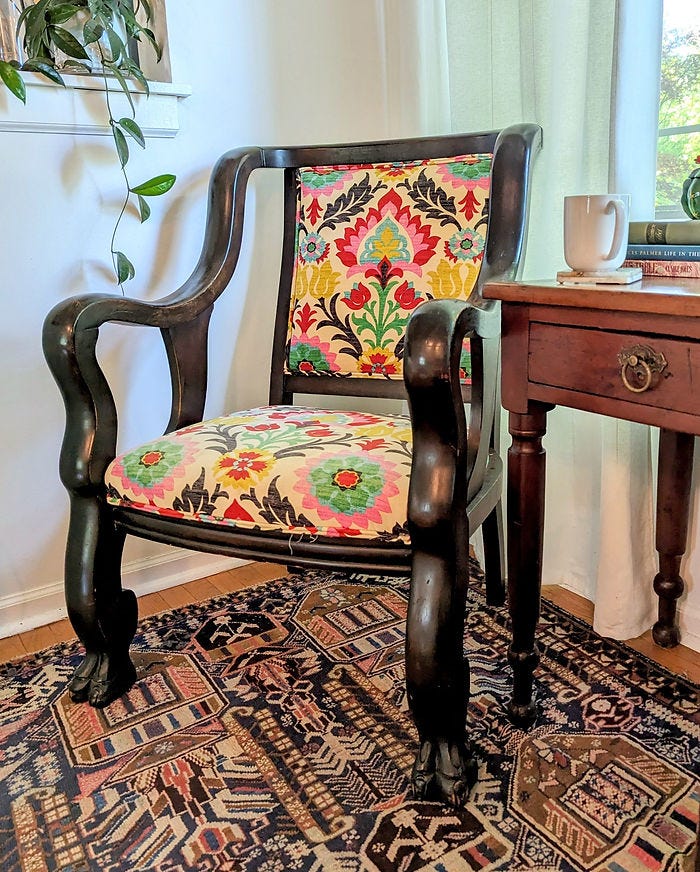
This chair, for example, was one of my mother's finds. She reupholstered it for her house, and then eventually it came to me. I chose this print for my first house (15 years ago?!) and now I'm planning to reupholster it again to blend more into our current house and decor. This time, I'm going to use one of my own fabric designs, and attempt to upholster it myself. (But after I learn how to make a walnut and stained glass door from scratch first. I have a list).
But even if you don’t have the impulse issues my mother and I share, or spend your free time at antique malls and thrift stores, or think taking on diy projects is a fun past time, repurposing quality furniture just makes sense, from every angle you look at it. It’s cost-effective, environmentally friendly, and adds that special touch that makes your home feel like you.
Cost-Effectiveness
First, have you shopped for a couch lately? Expensiiiive. Even the ones that are not the greatest quality seem to cost a fortune. And believe me, you definitely want quality when it comes to things like your couch. Sure, you could get away with a not-comfy accent chair that you plop your stuff on after work, but if you’re not comfortable on your couch, you’ll likely end up buying a new one sooner rather than later.
Contrary to popular belief, reupholstering second-hand furniture can often be more cost-effective than purchasing new pieces. While the initial investment may involve upholstery fabric and professional services, the long-term savings are substantial. In many cases, the cost of reupholstering is significantly lower than that of buying a comparable new item of similar quality.
Case study: My friend, Suzy, is not only a talented artist and a super cool person all-around, but she is also the queen of the marketplace find. I have seen her turn some real ugly ducklings into drool-worthy statement pieces. I followed one of her most recent projects on her instagram stories with rapt attention and a touch of envy, and then had to ask for all the details to share as a prime example of how what we all should be doing with our furnishings!
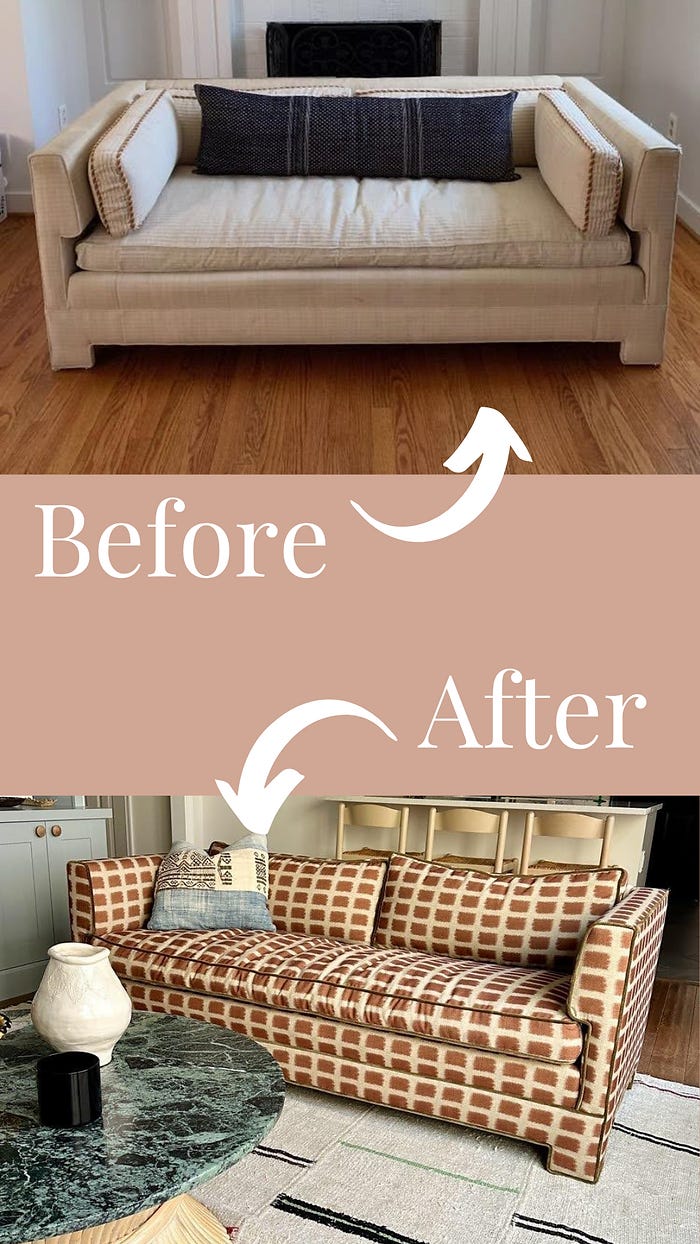
Her latest find was this couch from an estate sale. First, let’s point out that Suzy has a fantastic eye, and really knows her stuff. I will admit that if you are not in the habit of shopping for furniture second-hand it can be overwhelming and intimidating to know a good piece when you see it. But the more you look, the more you learn, and don’t underestimate recruiting a friend or even hiring someone to help you hunt for these pieces.
Back to Suzy and The Couch - Suzy knows a good foundation when she sees it. This couch was definitely worn, but had good lines, and a good structure to work from. She bought the couch for $25 from an estate sale. Sourced some vintage designer fabric for it on ebay for $300 (specifically linen ikat print with mohair velvet piping, for all you fabric fiends), and then had it reupholstered AND re-stuffed with feathers for $600. A top of the line couch, with designer fabric for under $1000?! Friends, I dare you to find something new of equal quality for a better price.
Reducing Waste
Which leads into my second argument for refreshing furniture. It’s so much better for the environment. In a world where fast furniture consumption is rampant, reupholstering offers a sustainable alternative. Rather than contributing to the cycle of mass production and disposal, we can extend the lifespan of existing furniture, ultimately lessening our environmental impact and promoting a more circular economy.
This article by the New York Times is pretty mind boggling. As a nation, we have developed a dependence for “fast furnishings” that quickly end up in our landfills, as we buy the next inexpensive but lesser quality piece. I don’t know about you, but I certainly feel better when I can find something second hand rather than buying it from a big box store.
I mean, my IKEA Pax hacks will always have a place in my home, because they are so dang versatile and functional and customizable. But I always start my hunt at the common second hand standards - FB marketplace, thrift stores, yard sales, antique stores, and estate sales. If you are willing to look around, you can find some great quality pieces for a fraction of what you could buy new.
Quality Craftsmanship
Let’s face it, furniture is not built the way it used to be. Fast furnishings are inexpensive because they don’t give us the heirloom quality craftsmanship that used to be the norm. And consequently, this sacrificing of quality for affordability forces us into a cycle of buying and disposing and buying, over and over. It’s nearly impossible to find that quality craftsmanship of yore at big box stores and online mega stores.
And don’t overlook those second hand pieces that have the sagging seat or worn out upholstery either! Those are some of the best finds, because with a little rehab and a fresh new fabric, you can still come out with a top notch, comfy, piece that will last longer than what you can have flat pack shipped to you, AND you get to give a new life to something that might just end up in the landfill.
And I’m not suggesting you diy everything here. I get it, not everyone has the time, skills, or patience for that. But I guarantee that you have local skilled artisans and craftspeople out there who are happy for your business. See, first you’ve saved something from the landfill, then saved money by buying a quality piece of furniture second hand, and now you are supporting small businesses and artists and craftspeople in your local community.
Have I convinced you yet?? Because I have one more enticing reason to reupholster an old piece of furniture…
Creativity and Beauty
...Fabric!!
Y’all know I love color, pattern and prints, and what better way to make something unique and truly your own than to recover an old or boring piece with a fresh, chic, fun fabric.
One of my main creative outlets is creating surface pattern designs, primarily for wallpaper. But any of my designs can be purchased as upholstery fabric as well. (I haven’t advertised it on my website much, but hit me up for details if you’re interested.) Just recently, my mom used one of my designs to reupholster a chair for her living room, and it turned out so great!
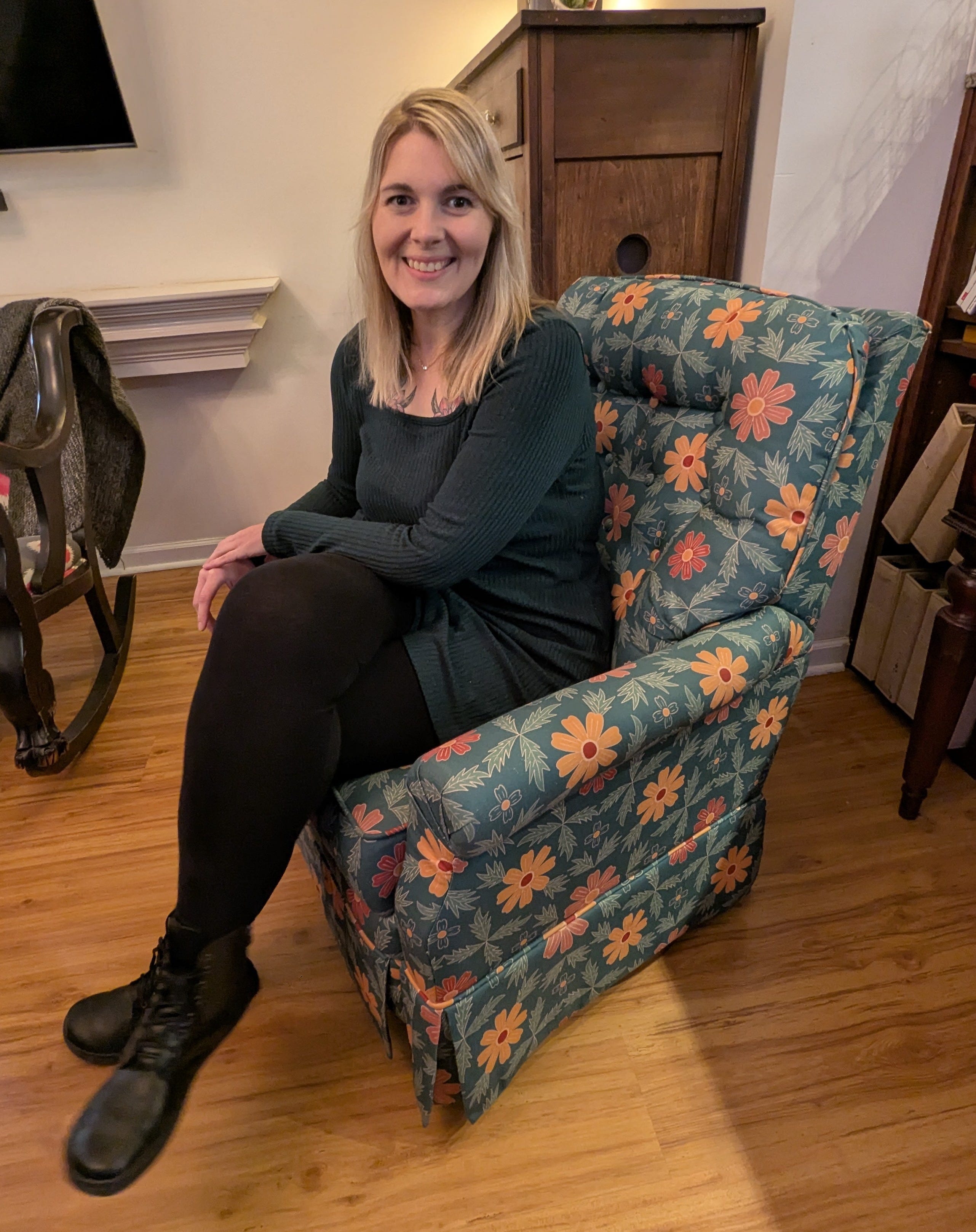
Like my wallpaper, the fabric is made-to-order thanks to print on demand technology. I know what you’re thinking: print on demand is a field littered with AI-emblazoned swag that you get at white elephant parties. And, yes, it can be. Yikes.
But on the flip side, this process allows artists and designers like myself to create work in a sustainable and environmentally-friendly manner, and customize everything from color to scale to a customer’s request.
Everything is made-to-order, so there is very little waste. Producing fabric on an as-needed basis helps reduce excessive inventory that has to be recycled or disposed of if it doesn't sell. I also chose to work with a company that is committed to sustainability, and recycles off cuts and misprints into filling for automobile seats. Their inks are non-toxic and water soluble, and there’s less water used in the printing process compared to traditional manufactured dyeing. The fabrics are printed in the US and sourced from vendors vetted for ethical work environments, and environmentally sustainable cotton production.
And while it may not be the cheapest route to production, I feel good knowing that I am not contributing to unethical workplace practices or overproduction. As an artist and designer, I value the creative voice we can all cultivate, through our own homes and our lives. I value craftsmanship and attention to detail. And I value working and consuming in an environmentally-conscious and sustainable manner when I can.
So, did I convince you to give reupholstering a try??
Maybe the next time you come across a neglected armchair at a flea market or a vintage sofa at a thrift store, consider the transformative power of reupholstering. And in a world where disposable consumerism reigns supreme, you can embrace another path - one that champions sustainability, creativity, and quality craftsmanship.